
The Truth About the Bernina 1130: A Beautiful Vintage Machine With a Hidden Risk

Updated: May 18

Finding a vintage sewing machine that feels special is one of those rare joys. When I came across a Bernina 1130 — a model many sewists consider one of the finest Berninas ever made — I was thrilled. It stitched beautifully, felt smooth and precise, and carried that unmistakable Swiss engineering charm.
But after taking it to Bamber Sewing Machines in Eccles, Salford, I learned something important that every vintage‑machine lover should know. This post shares that experience honestly, so others can make informed choices before investing in older computerised models.
Bernina 1130: A Stunning Machine… With a Vulnerable Heart
These images show the 1130’s stitch range and its beautifully designed front control panel — the features that give it such a loyal following.
The 1130’s reputation for stitch quality, metal construction and elegant engineering is well‑earned. Mine still sews beautifully, with every stitch function working exactly as it should.
However, the technician at Bamber’s explained something that isn’t widely known:
The 1130 is one of Bernina’s early computerised models.
If the circuit board fails, the machine cannot be repaired.
There are no replacement boards. No modern equivalents. No workaround.
He told me that while the 1130 is a joy to sew on, its electronics are now at an age where failure is unpredictable. It might last another year… or it might not. Once the board goes, the machine is finished.
It was Steve Bamber — one of the founder’s sons — who examined my machine. With decades of Bernina experience behind him, he explained everything with a calm, gentle honesty.
The way he described the 1130’s ageing electronics almost felt like giving a difficult diagnosis — not dramatic, just truthful and compassionate. His advice was simple: take it home, enjoy it, and use it as much as possible while it still has life left in it. It felt like being encouraged to make the most of something special while it’s still able to shine.
My Visit to Bamber Sewing Machines
The images above show Bamber’s old Deansgate shop in the 1980s, paired with their Eccles location, which has been home to the business since the 1960s. Images c/o Bamber Sewing Machines
Bamber’s is a long‑established, family‑run business (since 1946) and a main Bernina agent. Their knowledge is exceptional, and they specialise in both vintage and modern sewing machines.
Steve was incredibly helpful. He:
confirmed the electronic vulnerability of the 1130
explained why early computerised models are a gamble
showed me safer vintage alternatives
Before I left, Steve asked whether I was sure I wanted to go ahead with a full service. With decades of Bernina experience behind him, he explained that because of the machine’s ageing electronics, the 1130 could fail at any time — even immediately after being serviced. The service itself was excellent value at £109 plus parts and VAT, but it didn’t feel right to invest in work when the circuit board could give out without warning. In the end, Steve’s honesty made the decision clear.
He then kindly cleared out the lint (there was quite a lot!), showed me how to remove the metal stitch plate, and oiled the machine — all free of charge. That, to me, is excellent customer service.
The shop itself is a delight: shelves of machines, original sewing adverts, and a gallery of Bernina and other models through the years. It felt like stepping into a little museum of sewing history.
Bamber's website has a great advice page for choosing a sewing machine, which you can read here.
The Safer Vintage Choice: The Bernina 830
Here’s the safer vintage alternative Steve recommended.
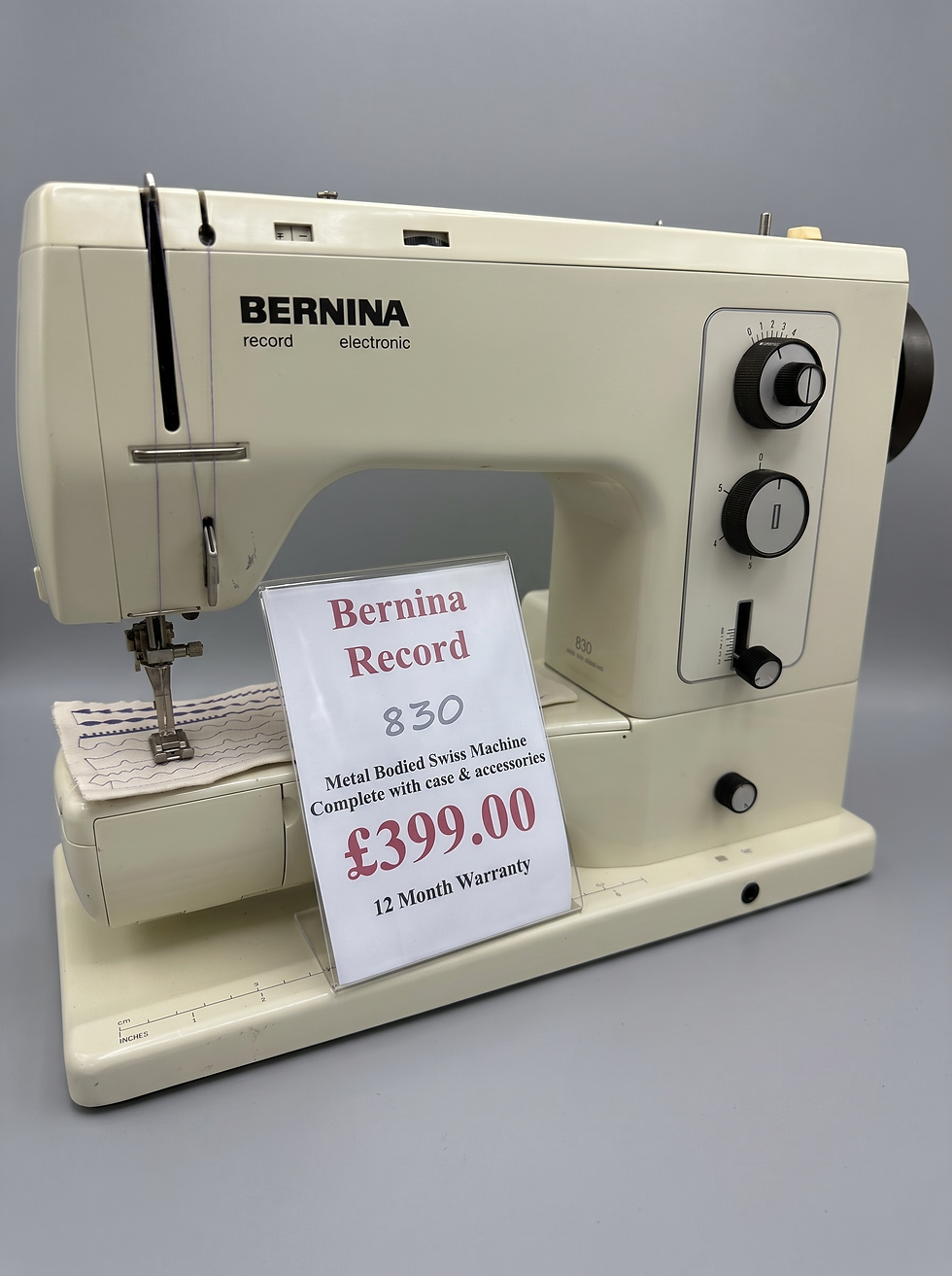
Steve showed me the Bernina 830 Record — a fully mechanical, all‑metal Swiss machine with no circuit boards at all. This is the model he recommends to anyone wanting a vintage Bernina that will last for decades.
The 830 can always be repaired.
The 1130 cannot function once the board fails.
Seeing the 830 made everything clear. If I ever buy another vintage Bernina, that’s the one I’ll look for.
The Modern Option: The Bernina 325 With a 7‑Year Guarantee

While I was at Bamber Sewing Machines, I was also shown the Bernina 325 — a compact, modern Bernina with a 7‑year guarantee. After learning about the risks of early computerised models like the 1130, the reassurance of a long manufacturer's warranty suddenly made perfect sense.
The 325 offers modern precision, digital stitch control, and the reliability of brand‑new electronics, making it a strong contender for my next studio machine. It’s now firmly on my Christmas list.
My Backup Plans: The Singer Denim & Brother
Every sewing room needs a reliable safety net, and I’m lucky enough to have two very different, very capable "second-in-command" machines. While my main machine does the heavy lifting day-to-day, these two backups ensure I’m never stuck, no matter the project.

The Vintage Gem: Brother Star 120E
My first backup has a lovely history. This Brother Star 120E was originally purchased in Surrey back in the 1990s by my mother-in-law. Since she wasn’t a frequent sewer, it sat virtually unused for decades before being passed down to me. After a professional service, this "low-mileage" treasure is running like new.
It’s a wonderful example of a "hybrid" machine—it features a computerised brain for precise stitching, but you still use a satisfying, tactile dial to click through its 27 patterns. I particularly love the speed control slider on the front; it’s perfect for slowing things down to a crawl for intricate work. It’s a sturdy, no-fuss workhorse that is always ready when I need a delicate touch.

The Modern Muscle: Singer Heavy Duty 6335M Denim
While my Brother remains the machine I reach for when I need absolute precision, the Singer Heavy Duty 6335M has long been the “muscle” of the room — or at least, that’s how I thought of it when I added it to my studio in August 2023.
It’s a good, reliable mechanical machine with a fast motor (1,100 stitches per minute) and enough strength to handle thicker fabrics like denim, canvas blends, and upholstery layers. With 32 built‑in stitches and a straightforward, no‑nonsense feel, it has always been a practical partner to my more computerised Brother.
But after learning more — and speaking with the technicians at Bamber Sewing Machines, where it’s currently in for a full service — it’s clear that the 6335M isn’t a true heavy‑duty machine in the industrial sense. It doesn’t have the internal engineering, torque, or build of a genuine industrial straight‑stitcher. And while it will sew denim, it’s really happiest with one or two layers, not the multi‑layer stacks that industrial machines take in their stride.
What it is, though, is a dependable domestic workhorse that fills the middle ground beautifully: more robust than a standard domestic, but not pretending to be an industrial giant. Perfect for top‑stitching a workwear jacket, assembling an oilcloth wash bag, or tackling those slightly tougher projects that need a bit more push than finesse.
And in a small home studio like mine, that balance is often exactly what’s needed.
Final Thoughts
So Was Buying the 1130 a Mistake
Not at all.
It’s a beautiful machine — a joy to sew on and a little piece of Bernina history. I absolutely love it, and I’m grateful I get to experience sewing on something so thoughtfully engineered. What’s changed is simply my understanding of its place in the studio.
It isn’t a long‑term workhorse; it’s a machine to enjoy, appreciate, and make the most of while it’s still running well. A companion for the present moment rather than the machine I’ll rely on for the next decade.
If you’re considering a vintage Bernina, here’s the key takeaway:
Mechanical models are safe.
Early computerised models are a risk.
The 1130 is wonderful — but unpredictable.
The 830 is wonderful — and reliable.

Don't take a machine with a circuit board problem to a sewing machine place. They don't know how to fix circuit boards Old 1130s always come with a blown X cap and the inter board connectors corrode. Clean those two things up and It will be fine.